Thursday, February 25, 2016

Chapter Seventeen Visual Sources

"Ways of the World"
Chapter Seventeen Visual Sources
Considering the Evidence: Experiencing Industrialization
1750-1914

For todays assignment the class was to read the documents, distinguished in purple, at the end of the chapter. These documents are meant to better connect and help the reader understand what was talked about in the chapter with testimonies, art, and works of literature from that time.

The document or visual source I chose to examine was Visual Source 17.4 "Inside the Factory: Lewis Hine, Child Labor, 1912 (Oil over photography, 1912, by Lewis W. Hine. The Granger Collection, New York)" on page 875. For those of you who have the book feel free to go take a look at the photo before proceeding to read on. Unfortunately, for those who do not, and considering that I have a growing following in Europe, I was unable to find the exact photo to post, but luckily I found some other images from Lewis Hine that will be incorporated in this entry.

The bulk of this chapter is about the Industrial Revolution, but precisely the working conditions, economics, and environmental effects the Industrial Revolution had. In Lewis Hines photo Inside the Factory the typical working conditions and workers of factory life are portrayed. This resonated with me because it is one thing to hear, talk about, and analyze what was happening during this time period but a whole other dimension is opened when there is visual evidence and context to back it up. Photos that help wrap the mind around how dehumanizing and filthy the conditions were.

The following are other photos taken and captioned by Lewis W. Hine.

The Factory: Some of the young knitters in London Hosiery Mills. London, Tennessee.  
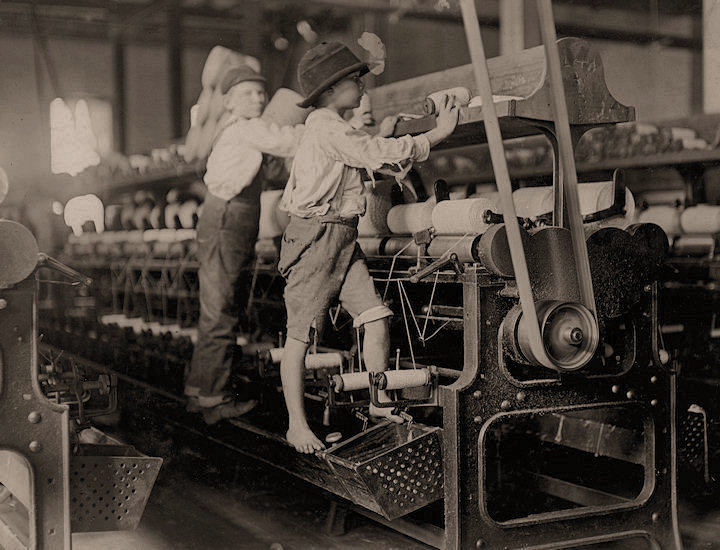
 
The Mill: Some boys and girls were so small they had to climb up on to the spinning frame to mend broken threads and to put back the empty bobbins. Bibb Mill No. 1. Macon, Georgia.


Variety of Jobs: Young boys working for Hickok Lumber Co. Burlington, Vermont. 


Field and Farm Work: Camille Carmo, age 7, and Justine, age 9. The older girl picks about 4 pails a day. Rochester, Mass.     

As can be determined from above, during this time period there were a lot of children- boys and girls- working in these factories, farms, seafood companies, salesman positions and other places under stressful conditions. It is then eye opening to see young men and women preforming task that nowadays would be preformed by someone 18 or older (a legal adult in America). The photos help in adding the needed dimension when really trying to uncover what was really happening during the Industrial Revolution. As well as the people who helped really grow and expand the overall essence of the revolution.
For more photos from Lewis W. Hide visit: http://www.historyplace.com/unitedstates/childlabor/

Tuesday, February 23, 2016

Chapter Seventeen: Revolutions of Industrialization

"Ways of the World"
Chapter Seventeen: Revolutions of Industrialization
1750-1914

In this chapter I focused on two things: The section on "Why Europe?" and "Map 17.5 of Latin American and the world, 1825-1935"

The reason why I focused on 'Why Europe' is because in an odd way I take interest in Eurocentric ideas and happenings of the past due to the fact that its effects still echo in today's society. The section was mainly making a stance that Europe, more specifically Great Britain, were not the only ones undergoing new innovation and discoveries. The book makes reference to the "Islamic world [who] generated major advances in shipbuilding, the uses of tides and falling water to generate power, paper making, textile production, chemical technologies, water mills, clocks, and much  more" (pg 831). Along with the Islamic world Stayer offers many other civilizations also advancing industrially. I found it particularly interesting that Strayer states that Europe in fact during this time had no obvious economic lead in comparison to other countries.

Moving on Map 17.5 on page 855 was helpful for me personally. I have in fact seen this map before but sometimes I can be visual learner and this map is colored has pictures and is still informative. I just appreciate the fact that I feel Strayer genuinely tries to implement a little of everything as far as learning and obtaining information goes.


Monday, February 15, 2016

Chapter Sixteen: Atlantic Revolutions, Global Echoes Continued

"Ways of the World"
Chapter Sixteen: Atlantic Revolutions, Global Echoes &
Part Five: The European Moment in World History
1750-1914

In this portion of the chapter the main thing I focused on was the section on Feminist Beginnings. I hate to bring this back down to race but I find it interesting and a little hypocritical that while all these women were fighting for equal rights it seemed as though the discrimination of colored people was irrelevant or non-existent.It wasn't mentioned once. Everyone wants equality but only if its in their favor. I actually find it kind of annoying. Moving on, the most engaging thing I read in this section was about the violence that some of these feminist groups had. The "campaign of violence that included blowing up rail stations, slashing works of art, and smashing department store windows." happened through this thought to be peaceful enlightenment for women's rights. Blowing up railroads? I think I that point women's rights should have been handed out on silver platters.

Thursday, February 11, 2016

Sun Flowers with the Sisters

Sun Flowers with the Sisters
February 11th, 2016


 On today's agenda for Foundresses' Week 2016 was "Sunflower Power!" from 2:45-3:45 p.m. The reason why the plant of choice was sunflowers was due to the fact that Julie's favorite plant, in fact, was a sunflower. Although she has been deceased for centuries now this was a great way to keep her memory alive. This event went smoothly and was actually relaxing. While planting sunflowers around camps many of my friends asked what I was doing and once I caught them up to speed they told me what we were doing was "pretty dope." All in all it was a quality experience.

Wednesday, February 10, 2016

Julie Billiart and Francoise Blin de Bourdon

Julie Billiart and Francoise Blin de Bourdon
Founders of the Sister of Notre Dame (February 2, 1804)
During the French Revolution

This article was definitely an interesting one. Can I just state randomly that my computer is insisting on changing "Bourdon" to Bourbon, I doubt the sisters had much of that...Back on topic, one of the main things I noticed reading this article was how exponentially different these two women were. They could not have been more contrasting. Francoise was from a family of landowners and aristocrats in the second estate. She had a fairly lavish and resourceful childhood attended school in the warm months to learn how to properly take care of a household and family and took up gardening a little later in life. As the text put it "Francoise was getting used to being the only child left with her parents in their large home at Bourdon. Her world was spacious and her freedom of movement within it was complete, but few intimate relationships filled those abundant empty spaces around her." On the other side of the spectrum Julie who, what doctors today say, had multiple sclerosis. She could barely talk and was limited to a chair/wheelchair because she could not move. However, unlike Francoise, Julie was born into a third estate family (the lowest estate) but later down the line mad connections with people from the first and second estate which lead to her going into hiding by affiliation. 
Yet the most interesting items I read about were not until the end of the article. Now, when I think about or hear the word nun or sister, I do not think jail. So I was mildly entertained when I read that Francoise this second estate aristocrat woman had been arrested and imprisoned for, give or take, a year. Obviously it was due to her and her family's status and affiliation to Louis XVI but nevertheless they were in jail. I also found it gripping that Francoise's father was executed by the means of guillotine and, not in the same way but, her husband was also executed closely after. Lastly, I thought it shallow of Francoise because it stated that upon first seeing Julie, Francoise was appalled by her condition, little did she know that Julie would become like her sister and they wold have a progressive and impacting 10+ years together.

Monday, February 8, 2016

Chapter Sixteen: Atlantic Revolutions, Global Echoes

"Ways of the World"
Chapter Sixteen: Atlantic Revolutions, Global Echoes &
Part Five: The European Moment in World History
1750-1914

This first section of the chapter and second section of history in this book was more, dare I say, entertaining. Aside from it being a reasonable and easy read, I did find a few thing that stood out to me. The first belonging to the first paragraph of the chapter starting with Haiti. Apparently twenty-one years after the Haitians succeeded in breaking away from the French colonial rule, the French demanded Haiti to repay some "150 million gold frances in compensation for the loss of its richest colony and its 'property' in slaves," and "with French warships hovering offshore, Haitian authorities agreed." Now if that isn't bullying I don't know what is. This of course put Haiti in a sea of debt but later down the line- 185 years later in 2010- once disaster struck Haiti, the French government decided to pay back "$17 billion, effectively returning the 'independence debt'..."
Secondly, what I find pretty funny, but it is definitely not in retrospect, is the handy dandy guillotine execution practices. Mainly I find this humorous because it was actually a serious way of killing someone during that time- by beheading them- it just reminds of Alice in Wonderland. The only thing I can give them on that is that it was effective.
Last, although this may be more towards Strayer's style, is how he uses the word 'Act' to describe each revolution. He refers to 'Act One' as the American Revolution, 'Act Two' as the French, and so on for the Haitian and Spanish Revolutions. It takes me back to World Literature or Literature/English classes in high school where the separation of major events are divided by Acts. It almost, for me at least, make me think that in some parallel these events were becoming more and more predictable perhaps. Implying that for each revolution there are, while varied, the same major turning points each revolution. Now maybe I am just not hip on history lingo and maybe they're all commonly referred to as acts but if that is not the case I stand by my interpretations.

Wednesday, February 3, 2016

Chapter Fifteen: Cultural Transformations Continued

"Ways of the World"
Chapter Fifteen: Cultural Transformations Continued
Religious and Science
1450-1750

In continuation to my previous entry, the second half of chapter fifteen was by far, for myself at least, more tasteful. In all honesty I was not quite sure what I was expecting the next portion of the reading to be about (even though it is in title of the chapter) but nonetheless I was pleased to finally dabble in the sciences. I for one enjoy the majority of the sciences: psychology. physics, astronomy etc. So a lot of the names that made major contributions to the scientific community and Scientific Revolution in the early modern area stood out due to the fact that some theories, principles, and equations have stood the test of time and remain true and applicable even today. Men such as: Nicolaus Copernicus, Galileo Galilei, Rene Descartes, Issac Newton, Blaise Pascal, and Immanuel Kant to name a few. Along with that I picked up on three things I found to be relevant and or interesting.This chapter will on religion and sciences not only examines one and the other but also analyzes the problems that arose between the two upon becoming more and more of interest. "...Requiring neither God nor angels to account for its normal operation. Knowledge of that universe could be obtained through human reason alone- by observation, deduction, and experimentation- without the aid of ancient authorities or divine revelation"(Strayer 744). This I believe is important when trying to see the real branching away the sciences started from the churches views of earth, the human body, and space. I find it refreshing to see how people were no longer satisfied with the 'that is the way God intended it to be' people, men and women (mostly men), were looking for more fulfilling answers with or without the church's approval. Another interesting phrase I picked up on but will not go in depth about was "natural religion" that was apparently "a conception of religion shaped by the outlook of science. The last relevant issue that stood out to me was the extreme under representation of women during the Scientific Revolution. While it is not surprising per-say it is mind boggling to really examine the prejudice against women or any particular group during this time period.

Tuesday, February 2, 2016

Chapter Fifteen: Cultural Transformations

"Ways of the World"
Chapter Fifteen: Cultural Transformations
Religious and Science
1450-1750

The first half of this chapter thus far I saw immediately an under representation of the African culture/religion. While it is obvious and made relevant in the beginning of the chapter that the Europeans where pressing there religious views of Christianity upon everyone they conquered, there is only a short paragraph (page 34) on the Afro-Asian religious practices. Since only the first half of the chapter was assigned for reading I will not go as far to say that the entire chapter under represents the spirituality, rich, and essentially foreign religious practice people such has the Haitians, Cubans, Brazilians, and West Africans practiced; however this far in the reading I would have to say that is the case. The thing with history for me, personally, is that there is always going to be a group under represented in textbooks or even lectures. It is at times unfortunate in retrospect to see how even today Eurocentric ideas and history are still the go to and spotlight of almost everything. Am I saying that as a culture and society we didn't grow from there "encounter", if you will, in the Americas? Of course not. I just find it interesting to see how history is portrayed in instances where the focus is on Europeans or the British. The first piece of the chapter only briefly talks about how African religious ideas and practices took form in their own versions of Christianity even though they were being suppressed to comply completely with European Christianity globalization. But the sections fails to elaborate on how those ideas and practice were nonetheless integrated and applicable today.