Wednesday, March 23, 2016

Chapter Nineteen Visual Sources

"Ways of the World"
Chapter Nineteen Visual Sources
1750-1950

In this section of visual documents I decided to focus on Visual Source 19.2 "Women and Westernization (Museum of Fine Arts, Boston, Gift of Aaron Lebowich...)" Displayed below.


I chose this image because I believe it accurately portrays how westernization took its toll in Asia. As the book mentions the photo in the middle more precisely "reflect[s] earlier Japanese court traditions that encouraged women to wear many layers of kimonos" (Strayer 968). The other photos however illustrate more of  the westernization taking place in particular the style of dresses and the structure of the building on the left. Yet the Japanese culture still remains prominent which can be picked p from the overall scenery, trees, flowers, and patterns.

Monday, March 21, 2016

Chapter Nineteen: Empires In Collision

"Ways of the World"
Chapter Nineteen: Empires In Collision
1750-1950

In this chapter I was able to fully immerse in it. Partly because I am fairly interested in the events that took place in the Asian culture. To make it clear I'm not particularly interested in actual Asian culture but I suppose more accurately how it all came to be. There empires and such really draw my attention. So I was pleased to see that the portrait on page 940 portrayed Lin Zexu "Confronting the Opium Trade". Something I have always found intriguing about the Chinese was how they handled the arising and mass distribution of opium. The correlation I prefer to draw/analyze is how in America some hoe we let cocaine, meth, crack, heroine, and other hard core drugs infiltrate or country with really no effective "cleansing" system one could say. Inevitably leading to the massive exponential growth and seeming popularity of each. Yet Lin Zexu when he picked up on the dangers of opium made some tough decisions to rid his empire of the dangerous and devastating drug. Lin's reasoning came from "moral appeals, reasoned argument, political pressure, and coercion..." Lin tried his hardest to avoid physical conflict. Lin in my opinion made tremendous efforts. For example he "emphasized the health hazards of the drug and demanded that everyone turn in their supply of opium and the pipes used to smoke it". I thought this in itself was genius. The one thing the majority of America is not doing or maybe doesn't realize is that drugs while they are considered "bad" are a health issue, however we as a country are failing to treat it as much and only enforce the criminal side of it. Think about it this way you can throw a user in jail for a few days and maybe even years for possession but once they come out they are going right back to what they know, right back to what their body and minds are telling them they need, right back to using. In turn with Lin making these demands "he had confiscated some 50,000 ponds of the drug together with over 70,000 pipes and arrested some 1,700 dealers." Lin did not stop there and traced the problem back to the source which was mainly the English during the time frame of Queen Victoria. he essentially stated that the empire supplies them with textiles that enhance their lifestyles so why are they importing and selling this drug that devastated his people. With that he made the decision to with hold from trading with them giving them the option to stop selling to his people and give p their supply with no compensation. After a few weeks of negotiation the "Europeans...turned over some 3 million pounds of raw opium to Lin Zexu. All of which he soiled and released into the ocean.                              

Wednesday, March 16, 2016

Chapter Eighteen Documents

"Ways of the World"
Chapter Eighteen: Documents
Colonial Encounters in Asia and Africa
1750-1950
The document I chose to focus on for this blog entry was Document 18.1 Seeking Western Education. It starts off by giving a brief description of the man whose perspective we will be given throughout the actual document. "Ram Mohan Roy (1772-1833), born and highly educated within a Brahmin Hindu family, subsequently studied both Arabic and Persian, learned English, came into contact with British Christian missionaries, and found employment with the British East India Company" (Strayer 913). He became well know for his dedication to reform religious and social ways of life/living. From the beginning of this document it is clear to understand his Ram's passion for what he has sought out to do. His actual document titled "Letter to Lord Amherst" in 1823 essentially tells of how he was ecstatic for a new Sanskrit School in Calcutta to be established by the government saying how "[Their] hearts were filled with mingled feelings of delight and gratitude" (Strayer 914). Ram later realizes that this new school he thought would be of prestige and aide in lifting this Indian culture out of there outdated Hindu based education system was on the contrary going to be established under Hindu Pandits- Hindu learned teachers. Thus contradicting everything Ram thought the school would accomplish being that schools in India were already currently teaching in the same way. He states, "this seminary can only be expected to load the minds of the youth with grammatical niceties and metaphysical distinctions of little or no practical use to the possessors or to society" (Strayer 914). Basically emphasizing that the school is only going to continue to reinforce their out of date thinking. He even goes as far to state that "[T]he Sanskrit system of education would be the best calculated to keep this country in darkness" (Strayer 914).


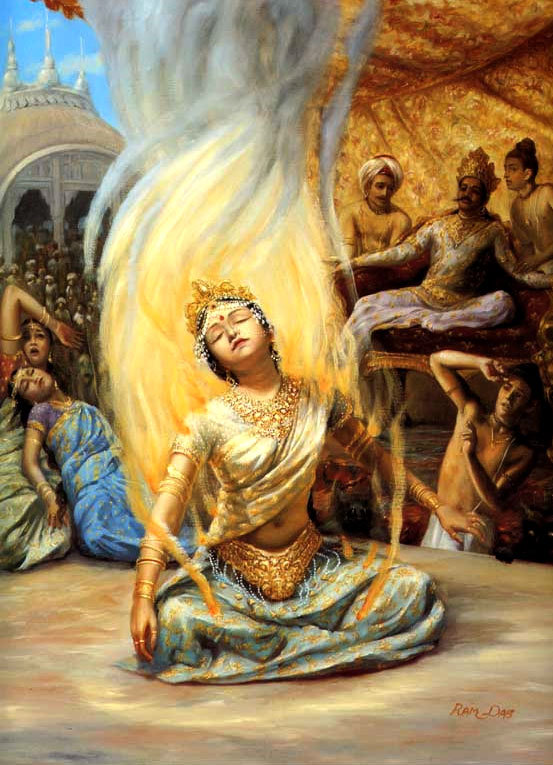
One of the examples Ram uses to illustrate how this Hindu way of thinking was outdated and one of the main aspects he focused his energy on ending was sati*. Sati was essentially a "...practice in which widows burned themselves on their husbands funeral pyres" (Strayer 913). The images below depict how not only normal but culturally acceptable and expected this practice was.


*Sati (also called suttee) is the practice among some Hindu communities by which a recently widowed woman either voluntarily or by use of force or coercion commits suicide as a result of her husband's death.


    For copyright purposes I will just go ahead now and say I do not own these images.
     

Chapter Eighteen: Colonial Encounters in Asia and Africa

"Ways of the World"
Chapter Eighteen: Colonial Encounters in Asia and Africa
1750-1950

In this chapter there were more phrases and facts that stood out to me throughout the chapter. In comparison to just one section catching my interest the fact that different phrases caught my attention was interesting in itself. The first piece of information was early on, the book states,

"The enormous productivity of industrial technology and Europe's growing affluence now created the need for extensive raw materials and agricultural products: wheat from the American Midwest and southern Russia, meat from Argentina, bananas from Central America, rubber from Brazil, cocoa and palm oil from West Africa, tea from Ceylon, gold and diamonds from South Africa. This demand radically changed patterns of economic and social life in the countries of their origin...[Europe] produced more manufactured goods than its own people cold afford to buy" (Strayer 880).

I just find this more on the ironic side that all these countries are growing and making products during the Industrial Revolution but when it comes down to it the people supplying all these products couldn't afford it themselves.

Another piece of text I found interesting was on the next page over when it begins to get into imperialism,

"...imperialism promised to solve the class conflicts of an industrializing society while avoiding revolution or the serious redistribution of wealth" (Strayer 881).

This is pretty much as it reads so no explanation is relevant but I found the concept of it interesting.

The next quote I pulled from this chapter stated,

"Imperialism, in short, appealed on economic and social grounds to the wealthy or ambitious, seemed politically and strategically necessary in the game of international power politics, and was emotionally satisfying to almost everyone" (Strayer 882).

To me the concept of imperialism rationalized as well as justified the way many things were done during this time. It might not have made everyone happy nonetheless it was plausible and satisfied basic needs (whatever those needs/desires might be).