"Ways of the World"
Chapter Eighteen: Documents
Colonial Encounters in Asia and Africa
Colonial Encounters in Asia and Africa
1750-1950
The document I chose to focus on for this blog entry was Document 18.1 Seeking Western Education. It starts off by giving a brief description of the man whose perspective we will be given throughout the actual document. "Ram Mohan Roy (1772-1833), born and highly educated within a Brahmin Hindu family, subsequently studied both Arabic and Persian, learned English, came into contact with British Christian missionaries, and found employment with the British East India Company" (Strayer 913). He became well know for his dedication to reform religious and social ways of life/living. From the beginning of this document it is clear to understand his Ram's passion for what he has sought out to do. His actual document titled "Letter to Lord Amherst" in 1823 essentially tells of how he was ecstatic for a new Sanskrit School in Calcutta to be established by the government saying how "[Their] hearts were filled with mingled feelings of delight and gratitude" (Strayer 914). Ram later realizes that this new school he thought would be of prestige and aide in lifting this Indian culture out of there outdated Hindu based education system was on the contrary going to be established under Hindu Pandits- Hindu learned teachers. Thus contradicting everything Ram thought the school would accomplish being that schools in India were already currently teaching in the same way. He states, "this seminary can only be expected to load the minds of the youth with grammatical niceties and metaphysical distinctions of little or no practical use to the possessors or to society" (Strayer 914). Basically emphasizing that the school is only going to continue to reinforce their out of date thinking. He even goes as far to state that "[T]he Sanskrit system of education would be the best calculated to keep this country in darkness" (Strayer 914).
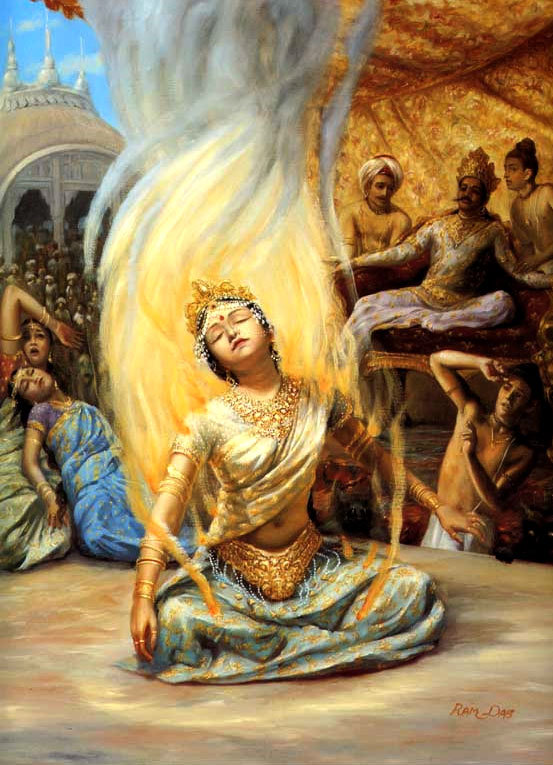
One of the examples Ram uses to illustrate how this Hindu way of thinking was outdated and one of the main aspects he focused his energy on ending was sati*. Sati was essentially a "...practice in which widows burned themselves on their husbands funeral pyres" (Strayer 913). The images below depict how not only normal but culturally acceptable and expected this practice was.
*Sati (also called suttee) is the practice among some Hindu communities by which a recently widowed woman either voluntarily or by use of force or coercion commits suicide as a result of her husband's death.


No comments:
Post a Comment